Author Archives: Nick Weir

Offer support for a new dairy herd in Stroud

One of Stroudco Food Hub’s longest standing producer members is looking to expand but would like reassurance from as many potential customers as possible before taking the leap.

Stroud Community Agriculture (SCA) has been farming 50 acres on the outskirts of Stroud for ten years and has recently supported the purchase of an additional 40 acres on Wick Street in the Painswick Valley. SCA has been selling biodynamic vegetables and meat through Stroudco for eight years and is now looking into setting up a micro dairy in spring 2017, with the aim of supplying the Stroud community with organic unpasteurised, raw cow’s milk.

Before committing to the expense of setting up a new dairy herd, SCA would like to hear back from as many people as possible about their interest in raw milk. They have set up a very brief survey here

Wine from Woodchester

We are very pleased to offer a wine made from grapes grown in the Five Valleys

bacchus

Bacchus is a delicious, aromatic dry white wine with a distinctive fruity bouquet and hints of elderflower coupled with refreshingly crisp finish and is made from 100% Bacchus grapes grown in three vineyards around Stroud.

This wine is a great alternative to a new world Sauvignon Blanc and pairs well with fish, chicken and creamy pasta dishes.

Bacchus is produced by Woodchester Valley Vineyard - a family owned, boutique, Cotswold Vineyard creating a selection of still white, rose and sparkling wines. The grapes are grown at three vineyard sites; The first planting took place in Amberley in 2007, then Woodchester in 2012 and Stonehouse in 2013. Woodchester Valley Vineyard currently have 45 acres under vine with a total of 60,000 vines.

Grape varieties include: Bacchus (one of the most successful varietals in England) as well as Chardonnay; Pinot Noir; Pinot Gris; Pinot Blanc; Pinot Meunier; Regent; Seyval Blanc, Ortega and Solaris.

All the grapes are hand-picked so only the very best fruit are selected for these wines.

Woodchester Valley Vineyard use a sustainable approach to viticulture, working with the soil to promote healthy vines.

Click here to order a bottle of Bacchus - and maybe some delicious Single Gloucester cheese from Godsells Farm to go with it.

New delivery of store cupboard items

Stroudco is now taking orders for our next food drop on Saturday 9th January. We have recently stocked up on products from Essential - the workers’ co-op in Bristol who supplies all our ethically-sourced tinned/packet produce. To see the full range of local and strore cupboard items available on Stroudco Food Hub click on the ‘food hub’ tab or just pop in and see the food hub in operation any Saturday (excluding December 26th and January 2nd) from 12 noon to 1pm at Stroud Valleys School on Castle Street GL5 2HP

stroudco and tea towel

Very fresh Organic Citrus boxes - order now for Christmas

We are very pleased to introduce long-time Stroudco shopper Mark Parris (who has also been a regular Stroudco home delivery driver) who has recently started importing some of the most delicious organic citrus fruit that Stroud has ever tasted!

mixed citrus

The secret to the taste (and nutritional value) of this fruit is that it is picked just a few days before we get to eat it (in contrast to supermarket and wholesale fruit which is picked up to 3 weeks before it reaches our fruit bowls)

Mark lived for many years in Spain and ran a fruit shop there so has many contacts with Spanish producers. He has now started importing fruit direct from Juan Enrique Vallejo - an organic grower in Alhaurin de la Torre - south west of Malaga. Click here for more details of Mark and Juan’s very simple distribution process - Stroudco’s DIRECT SUPPLY of Organic Fruit and Vegetables from Spain.

The fruit is spectacular - to try it browse the options here (search for Juan) and get your order in by Wednesday 16th December for the last Stroudco food drop of the year on Saturday 19th December.

Juan farm

Order early for a Local Christmas

Last Christmas we had sold all our allotted turkeys by the beginning of December and had to disappoint several customers who had heard how good these Free Range Organic Bronze turkeys are.

medium roast turkey

So this year Juliet Holt-Wilson has agreed to assign even more of her special birds to us. We asked her to write a bit about how she rears such delicious turkeys;

“We rear chicks here from the day they are hatched. They are grown slowly to their full maturity, and fed GM-free organic grain without antibiotics. During the day, the turkeys are in fields and hedgerows doing what turkeys do, foraging and roaming about. They are brought in at night with the help of Blue, our sheep dog, to sleep in airy barns with plenty of places to roost.

We then prepare the birds on the farm to reduce stress at slaughter. Because they are slow- growing, fully mature and active, their dense meat structure benefits hugely in terms of flavour and texture by hanging or dry ageing. So we dry pluck, which is labour-intensive compared with quicker wet plucking. This means we can then hang the birds for a minimum of seven days in a cool temperature-controlled barn. It’s a traditional process which is difficult to do on a large scale.”

Stroudco is also pleased to welcome back Jo Neale with her delicious home-made Christmas puddings.
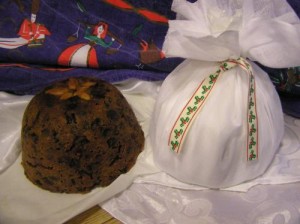
Christmas pudding

Jo’s Christmas puddings are lovingly made in small batches by hand in her Thrupp kitchen. She takes fair trade raisins, sultanas, currants, Bramley apples from her Dad’s garden, dark cane sugar, mixed peel, breadcrumbs, vegetable suet, flour, spices, flaked almonds, grated carrot, lemons, local free-range eggs and of course, brandy! When the mixture is well-stirred it is potted up and simmered for 14 hours in an Aga until it is moist and cooked. The finished puddings are cooled, wrapped in muslin and then kept in a cool dark place to mature for a few weeks before Christmas. This maturing process means that Jo’s deadline for orders will be 5th December.

Those of us who have tasted Jo’s Christmas puddings in previous years have already put in our orders on the Stroudco website, but if you want to reserve one for yourself make sure to get your order in before the cut-off date of 2nd December.

To see the full range of local produce available on Stroudco Food Hub or to download a catalogue go to www.stroudco.org.uk or just pop in and see the food hub in operation any Saturday from 12 noon to 1pm at Stroud Valleys School on Castle Street GL5 2HP



Lavender - as a fragrance, a food and a medicine - all locally grown!

Increasingly we are finding that people engage with Stroudco for one reason and then get involved in lots of other ways too. One example is one of our regular shoppers who then started helping on occasional Saturday mornings and has recently also become a producer member of the co-op too. This is her story….

Lavender bunch2 (3)

I think lavender is one of the most rewarding plants to have in the garden. Not only is it easy to grow – it’s a hardy perennial that largely takes care of itself, given a sunny well drained position – it is also the perfect plant to attract bees, and this is more important than it has ever been for the maintenance of our food supply.

Apart from harvesting my lavender at the end of the summer, there is little else I need to do. It’s organic because it thrives without any artificial feeding, so I just prune it back in autumn. There are 39 species of lavender, but I only have two, my favourite being the old traditional English Lavender (lavandula angustifolia).

Lavender belongs to the mint family, but is less well known than that herb for its edible properties. I must admit that I’ve never used it in baking, but I gather it creates a gentle floral flavour and fragrance in products such as scones or in sweetmeats like marshmallows. It’s included in the blend of herbs known as herbes de Provence (after the French region where it is grown profusely) and, allegedly, can be used as a condiment and in salads.

Norfolk lavender, grown to make eau de toilette, is a familiar concept, and the most common domestic use of the plant is for its fragrance. According to The Folklore of Plants by Margaret Baker (Shire, 1996) lavender was recorded in 1387 as being used in fragrant pillows for the benefit of King Charles VI of France, to repel moths. I like to use it similarly, to fill sachets, or mini pillows for use in clothes drawers. Not only is it very pleasant to hand-sew attractive fabrics and handle the fragrant dried buds, but the sachets also make ideal small gifts.

This year, however, I discovered another use for lavender. I sprained a ligament in my knee, and to soothe the damaged area a herbalist friend recommended massaging in a scented lavender oil, prepared by steeping the lavender in olive oil for a period of several weeks. It was very pleasant to use the scented oil, and my knee did feel better - though this may have been because of the psychological benefit of the scent!

To buy local lavender, see the full range of local produce available on Stroudco Food Hub or to download a catalogue go to www.stroudco.org.uk

Days Cottage will press your apples and bottle your juice for you

Days Cottage is one of the founder producer members of the Stroudco cooperative, having helped to set up the not-for-profit Food Hub in October 2006. Helen and Dave, the owners of Days Cottage Apple Juice, run a small business from their family farm in Brookthorpe pressing apples and producing delicious apple and pear juice blends as well as award-winning ciders and perry.

They are now offering to use their juicing and pasteurising facilities to produce apple juice and cider from your surplus apples. If you take your fruit to their farm they will wash it, put it through their scratter (which cuts up the fruit), then press it in their traditional apple press which produces one 75cl bottle of juice from each kilogram of fruit. Your fruit needs to be ripe and sound (not windfalls). The juice comes back to you in green screw top bottles which you can label and give away as Christmas presents or keep for up to two years – just in case next year’s apple harvest is not as bountiful as this autumn’s!

For producing apple juice you need to deliver a minimum of 100kg of fruit – ideally a mixture of cookers and eaters. Why not talk to neighbours and friends, pool your fruit and share the juice? If you want to make cider, you can take smaller quantities and collect your juice for fermentation using traditional local recipes available from the Gloucestershire Orchard Trust.

To book your apples in for juicing phone Helen on 07879 226031. Days-Cottage-Apple-Juices